Partner City
Trail
Silver City - A Smelter City


Nestled in a bend of the Columbia River in the West Kootenay region, Trail has been shaped by the land, the river, and the determined people who made their lives here. The area has been home to the Sinixt people since time immemorial, who knew the river and its resources intimately. European settlement came swiftly in the 1890s, when prospectors, miners, entrepreneurs, and smelter workers flooded into the valley following a mini-gold rush on nearby Red Mountain. Colonel Eugene Topping laid out the original townsite in 1892, and Trail grew rapidly from a rough riverside landing into an incorporated city by 1901. At its heart was the smelter, which was first built by Montana copper king Fritz Heinze in 1896 and then taken over by the CPR in 1898, before eventually becoming the world-renowned Consolidated Mining & Smelting Company of Canada (or Cominco, now Teck Trail Operations). That smelter drew waves of immigrants from Italy, Great Britain, Ireland, Eastern Europe, and beyond, creating a tight-knit, proud, and resilient working-class community. Today, Trail's historic architecture and stunning river setting make it a fascinating place to explore on foot. Lace up your shoes and discover the stories of the people, ideas, and industries that built this remarkable city.




This project is a partnership with the City of Trail and the Trail Museum & Archives, part of the celebrations of Trail 125. We also thank the Columbia Basin Trust, Teck Trail Operations, and FortisBC for their generous support.


Tours
Smelter City Stories
Trail Through Time
Gyro Park Quest
Exploring Trail's Playground
Trail History Quest
Riddles of Trail's Past
Explore
Trail
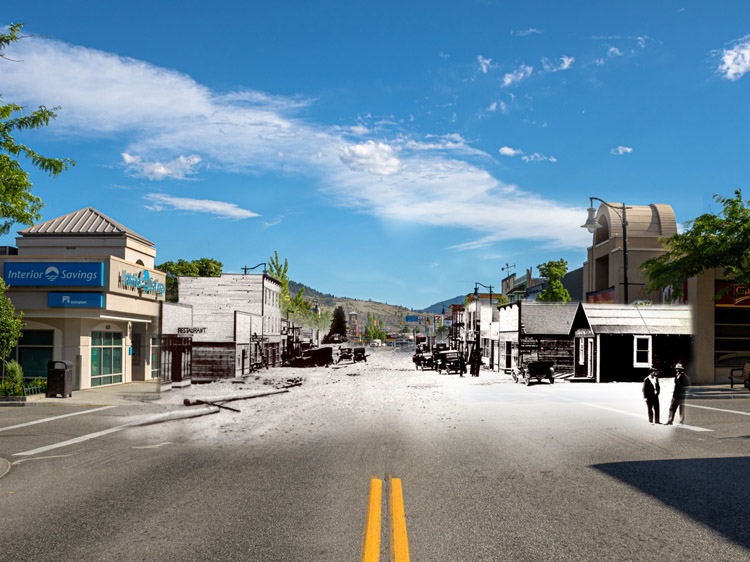
Then and Now Photos
Earliest Bird's Eye View


Trail Museum & Archives No. 4205
1896
One of the earliest surviving photos of Trail showing a view of the town taken from the mountains to the south, taken the same year that the smelter was constructed. The intrepid photographer must have had quite the day lugging his bulky early camera equipment up the mountain!
Dominion Day Celebrations


Trail Museum & Archives No. 1235
1898
A crowd of people are milling about in front of a festively decorated Crown Point Hotel to celebrate Dominion Day (today we call it Canada Day).
An American Parade


Trail Museum & Archives No. 1902
ca. 1900
A small band leads an early procession down Cedar Avenue past wooden storefronts and the Arlington Hotel. One of the flag-bearers is carrying an American flag and a man in an enormous garish costume just behind them appears to be dressed as Uncle Sam, indicating this parade might be celebrating America's July 4 Independence Day.
This would not have been an out of place sight in a town which drew so many American settlers early on, and maintained such close ties with American communities like Spokane just a short distance down the Columbia River.
An Early Trail Winter


Trail Museum & Archives No. 2043
ca. 1900
Smoke rises from the smelter's stacks over a snow-dusted Trail, the small huddle of buildings along the Columbia dwarfed by the surrounding mountains. By around the turn of the century the smelter, then under the management of Walter Hull Aldridge's Canadian Smelting Works, had already become the engine driving the young town's growth.
Hanna Opera House


Trail Museum & Archives No. 6296
ca. 1900s
This photo shows the intersection of Cedar and Helena, looking northwest towards the smelter. At the right you can see the front of a four storey building with balconies overhanging the sidewalk. This was Trail's Opera House. Built in 1897, it was a cultural hub for the community until its closure in 1922, when the high school was built on the spot. The Opera House was later reborn as the Strand Theatre just a couple blocks away on Cedar Avenue.
View from the Bay Ave Bridge


Trail Museum & Archives No. 4085
ca. 1900s
This photo shows the southern end of the Bay Avenue Bridge before Trail Creek was filled in. Notice the wooden planks in the foreground, showing the bridge deck. We see a variety of businesses lining either side of the bridge--the closer ones have been built up on stilts over the creek. The more substantial buildings in the background, the Crown Point Hotel at left and the Arlington Hotel at right, still survive to this day (in heavily altered form) and anchor the photo for the modern viewer.
Building the Railway Bridge


Trail Museum & Archives No. 2027
1912
In this photo we see Trail's first bridge connecting it to East Trail under construction. One of the truss spans has been put in place, and a large crane is working away at the left. The completion of this bridge later that year was a major milestone in the growth and development of the city.
Looking down Rossland Ave


ca. 1920s
A photo from the hills north of the Gulch looking down Rossland Avenue.


Trail Museum & Archives No. 1914
1920
en lined up outside the Bank of Montreal on C.M. & S. Co. Ltd pay day
The Smelter from the North


Trail Museum & Archives No. 6722
1925
This photo was taken from the mountain northwest of the smelter, whose huge belching smokestacks dominate the photo and are clearly filling the valley with great palls of smoke. From this angle they dwarf the City of Trail, which can barely be made out in the distance.


Trail Museum & Archives No. 7936
1927
Panorama view of street paving, corner of Cedar and Spokane
Smelter from Cedar


Trail Museum & Archives No. 5147
ca. 1940s
A view of the smelter looking up Cedar Avenue. If you look at the bottom you can see the railway tracks running diagonally across the street. The railway used to cut across downtown Trail, and many of the buildings along it were built in odd trapezoidal shapes to accommodate it. You can still see some of them today.
50 Years a City


1951
Marchers in majorette-style uniforms lead the 1951 Jubilee parade down a Trail street, with crowds lining the sidewalks and the smelter's smokestacks visible in the background, marking 50 years since the city's 1901 incorporation.
High Water Mark


Trail Museum & Archives No. 6390
1961
A moody picture of Trail taken at a moment when the Columbia River had swelled to such a point that it flooded the town and, as we can see, almost threatened to overwhelm the old bridge.
A Night out in Trail


Trail Museum & Archives No. 13898
1966
It looks like a busy and wild night out on Bay Avenue during the mid-60s. Notice the neon signs advertising the two main hotels, the Crown Point and the Arlington.
Rutted and Muddy


1897
A muddy, rutted Bay Avenue in the late 1890s, still scarred with tree stumps from clearing the townsite. Construction on Bay Avenue is rapid, as businessmen of all kinds are quickly taking advantage of the new market created by the hundreds of people who have come to settle in Trail to work at the smelter. The Arlington Hotel, built by R.T. Daniel in 1896 and once hailed as the finest hotel in the West, can be seen with its distinctive round cupola in the left middle distance.
Bay Avenue Storefronts


Trail Museum & Archives No. 1960
1898
A muddy, rutted Bay Avenue in the late 1890s, showing many stores with frontier-style false fronts. The Crown Point Hotel can be seen down the road in the distance.
Flooding on the Bowery


Trail Museum & Archives No. 78
1902
The stores and warehouses along the Bowery (today's Dewdney Avenue) have been fully inundated by the Columbia's waters during this major flooding event in 1902.
Spokane Street


Trail Museum & Archives No. 5182
1906
The four-storey Arlington Hotel rises over Spokane Street in 1906, its distinctive conical corner tower still intact. Built in 1896, the Arlington was once declared "the finest hotel in the West" by Lieutenant-Governor Edgar Dewdney.
The Rossland Stagecoach


Trail Museum & Archives No. 5238
1908
A horse-drawn stagecoach loaded with passengers waits outside the Crown Point Hotel in 1908, part of the regular run connecting Trail to Rossland in the years before the automobile took over the route.
Building the Trail Bridge


Trail Museum & Archives No. 2012
1911
The Trail Bridge is in its early stages of construction, in late 1911. The bridge was the first to connect Trail and East Trail, on the other side of the Columbia River, and when it was completed in 1912 it was a moment of enormous significance for the people of Trail.
Progress on Bridge Construction


Trail Museum & Archives No. 7268
1912
A photo in early 1912 showing ongoing construction of the Trail Bridge.
The Bridge Builders


1912
Some of the men who built the bridge over the Columbia proudly pose for a photo on one of the completed spans.
Children on Empire Day


Trail Museum & Archives No. 4078
1914
Children take part in street games and races on Bay Avenue during Empire Day. Empire Day was a holiday celebrating Canada's ties to the British Empire, marked here in Trail with children's races, picnics, and parades. Alongside Dominion Day and Labour Day, it was one of the town's major annual celebrations.
Because Britain no longer has an empire, and Canada is no longer part of it, the holiday was renamed Commonwealth Day in 1958, and today it is called Victoria Day.
Kids Sprinting


Trail Museum & Archives No. 1725
1919
A mob of kids sprint for the finish line during a race at Butler Park, cheered on by a crowd in the grandstand. The grounds were first cleared for baseball in 1902, with ferries carrying fans across the river to watch games, and the park later took its name from Sidney Butler, mayor of Trail from 1915 to 1917.
Firefighters in Action


Trail Museum & Archives No. 7519
1930
Firefighters battle a blaze at Cedar and Eldorado in 1930, hosing down a feed warehouse as smoke billows past the smelter stacks. The boxcars at right are a reminder that the rail line once cut diagonally straight through downtown Trail, a route that shaped the odd angles of several buildings still standing along Pine and Farwell.
Trail-Tadanac Hospital


Trail Museum & Archives No. 540
1932
The Trail-Tadanac Hospital on Victoria Street, built in 1925 with a wing added in 1932 to handle the town's growing population. The hospital served Trail until 1954.
Industry from the Air


Trail Museum & Archives No. 15340
1933
An aerial view from 1933 showing the smelter and, in the distance, the Warfield area where the company had recently begun fertilizer production. By this decade Trail's smelter had become the world's largest lead-zinc operation, and turning smelter byproducts into fertilizer was a direct response to complaints about smoke damage in the Columbia Valley.
Communion Class


Trail Museum & Archives No. 11873
1939
A First Communion class poses on the steps of St. Anthony of Padua Church in April 1939, the Romanesque Revival building serving the Gulch's growing Italian Catholic community. This original 1938 church would be destroyed by fire just four years later, in January 1943, and rebuilt to the same design.
The Two Trails


Trail Museum & Archives No. 13135
1942
A photo taken from the western mountains shows clearly Trail and its younger counterpart, East Trail, which we can see has rapidly filled out with suburban neighbourhoods in the three decades since the bridge was built.
Bay Avenue from Oak


Trail Museum & Archives No. 5408
1949
Looking west down Bay Avenue toward the smelter's stacks in 1949, the road lined with parked cars. The huge building at the right was initially built as the Fruit Fair Hall, an indoor farmer's market, before becoming Trail's Arena. The arena itself was later demolished after the opening of the Cominco Arena at the other end of Bay Avenue in 1951.
Andy's Coffee Bar


Trail Museum & Archives No. 12436
1952
A snowy day on Bay Avenue in 1952, with Andy's Coffee Bar anchoring the corner and a city bus rumbling past, a glimpse of Trail's mid-century downtown at the height of its postwar bustle.
A Flying Boat


Trail Museum & Archives No. 13066
1954
A Grumman Goose flying boat is moored at some very ramshackle looking docks on Trail's waterfront. It appears to have RCAF roundels, indicating it is in air force service. 36 Goose played an important role with the Canadian air force (among many others) in the Second World War, and after the war they were popular as bush planes in the remote Canadian wilderness.
The Central School


Trail Museum & Archives No. 12026
1920s
Students stream out of Central School in the 1920s. Opened in 1912 with eight classrooms, the school grew with an east wing in 1916, a west wing in 1918, and another addition in 1933, eventually serving as many as 1,000 pupils a year.
The Bank of Commerce


Trail Museum & Archives No. 12889
1930s
A 1930s postcard view of the Canadian Bank of Commerce, then housed in the old Arlington Hotel at Bay Avenue and Spokane Street. The bank had opened its first Trail branch in 1919 and wouldn't move into its own purpose-built building until 1938.
The Bluebird Cafe


Trail Museum & Archives No. 12430
1940s
The Bluebird Cafe at the corner of Bay and Eldorado, remembered for the neon sign of a bluebird with flashing wings. The building stayed a restaurant for most of the century, later becoming Ziebart's, the teen hangout of the 1960s with its basement U21 Club.
Cedar from Spokane


Trail Museum & Archives No. 6457
1940s
Cars line both sides of Cedar Avenue in the 1940s, with storefront awnings and a streetcar-era web of wires overhead, a snapshot of downtown Trail at its commercial peak.
An Event at Butler


Trail Museum & Archives No. 15543
1940s
There's huge turnout for an event at Butler Park in the 1940s. The crowds attention is centered on a speaker on the stage.
Bank of British North America


Trail Museum & Archives No. 5314
ca. 1899
A man and a woman are crossing a dusty Helena Street. Notice the wooden planks in the road's crosswalk, a reminder that these unpaved streets would turn into muddy morasses when it rained, and some provisions had to be made to make crossing the street palatable for pedestrians. The large building with protruding San Francisco style windows that dominates the left half of the photo was the Bank of British North America
Fruit Fair Hall


Trail Museum & Archives No. 4318
ca. 1900
Originally built in 1911-12 as a venue for the annual Fall Fair's livestock, canning, and produce displays, this Bay Avenue building doubled as an ice rink for hockey, curling, and skating, and even hosted the World Champion 1939 Trail Smoke Eaters and an NHL exhibition game between the Toronto Maple Leafs and Detroit Red Wings in 1934. It was demolished in 1951 after the new Cominco Arena opened.
The Creek Filled In


Trail Museum & Archives No. 1610
ca. 1911
This photo was taken just after the once-troublesome Trail Creek gully had been filled in with slag from the smelter, and Bay Avenue graded and fitted with sidewalks. The project finally opened up land along the creek that had been unusable for development since the town's founding.
Children Crossing the Bridge


Trail Museum & Archives No. 5227
ca. 1915
Children cross the steel bridge linking East Trail to the west side of the Columbia, completed in just six months and officially opened on May 24, 1912 — a crossing that opened the east bank to settlement and the growth of communities like East Trail and "Little Scotland."